
Maths Times Infinity > History > Cantor
Georg Cantor
{3/3/1845 - 6/1/1918}
Famous for investigating the concept of infinity. Mainly he did this using something called set theory.
The fear of infinity is a form of myopia that destroys the possibility of seeing the actual infinite, even though it in its highest form has created and sustains us, and in its secondary transfinite forms occurs all around us and even inhabits our minds.
Consider the counting numbers (positive integers): 1, 2, 3, 4, ... This sequence goes forever. Now compare it with the even numbers: 2, 4, 6, 8, 10, ... Well, this goes to infinity as well but surely it has only half as many elements as the original set. But we can line them up 1-to-1 which suggests there aren't any more in one than the other. This is called a bijection.
| 1 | 2 | 3 | 4 | 5 | 6 | 7 | 8 | 9 | 10 |
| 2 | 4 | 6 | 8 | 10 | 12 | 14 | 16 | 18 | 20 |
Now what if we consider rational numbers? All the possible fractions you can make? Surely there are more of those than there are positive integers. But again, there is a way to match them up 1-to-1 in another of those bijections.
All the (positive) rational numbers can be set out like this:
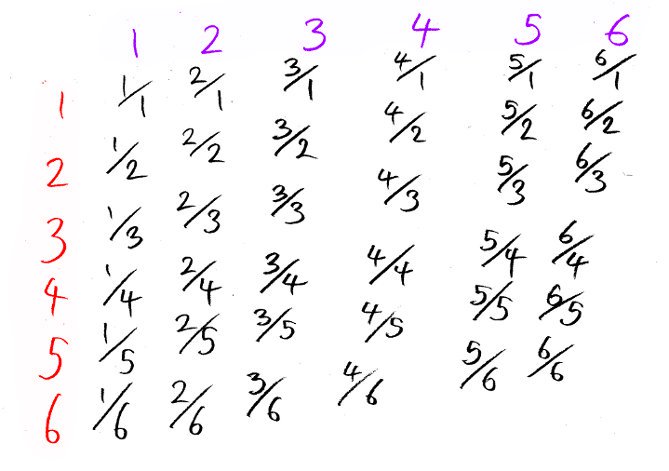
Some of them occur more than once but at least this covers all of them. Then we can traverse this full two-dimensional grid with a single long snakey line as follows:

Note that every fraction eventually gets hit by the line. It doesn't matter if it takes a long time as long as it takes a finite time. This proves that there are at least as many (positive) integers as (positive) rational numbers, which might seem strange.